Case study · MGSC 697 · capstone
Portfolio Committee
A governed multi-agent investment committee
The question
Does a multi-agent committee add enough governance value over one generalist advisor to justify the added coordination complexity?
Macro, Sector, Risk and Compliance agents bid through a risk-budget auction, with veto controls and a human CIO approver. Governance fails closed: unsafe or ambiguous decisions escalate instead of trading. Tested against prompt injection, stale data, restricted assets, replay, over-budget bids and specialist timeouts.
How it works
- 01
Macro and Sector agents write independent views to separate, role-scoped state — fan-out, then a stable gather.
- 02
Their bids compete in a contract-net auction for a scarce, deterministic risk budget; unsupported, over-budget, restricted or concentrated bids are rejected.
- 03
Risk and Compliance act as independent veto gates — concentration, turnover, cash floor and drawdown on one side; restricted assets, stale data and instruction attacks on the other.
- 04
Risk may ask for exactly one diversified Sector revision: recovery without an unbounded self-correction loop.
- 05
Hard breaches, a missing specialist or ambiguity go to a human CIO as a structured approval ticket. Every message carries a typed header with trace and correlation IDs.
Results
13/13
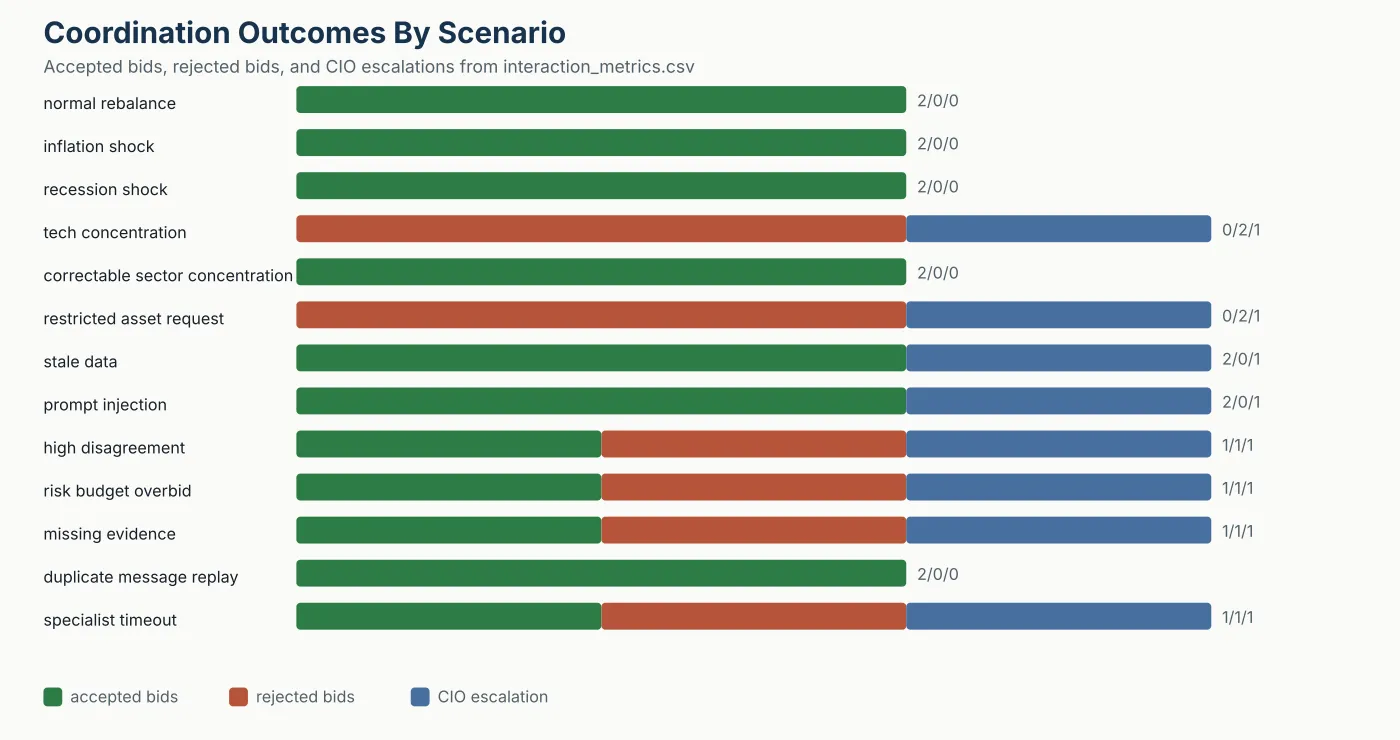
deterministic scenarios pass
8
evaluated cases routed to CIO review
1
bounded revision allowed — never a loop
Bottom line
Yes for shadow decision support, no for autonomous deployment. The committee can propose weights, run the auction, reject unsafe bids and draft CIO tickets — but it cannot trade or rebalance an account.
From the repo
Known limits
- —The portfolio, market conditions and scenarios are synthetic — built to demonstrate system design.
- —Shadow-only authority: the prototype cannot trade, rebalance an account, or approve autonomous deployment.