Case study · MGSC 695
Residual CNN + Grad-CAM
A custom vision model, and proof of what it learned
The question
Can a purpose-built residual network learn strong features from tiny 32×32 CIFAR-10 images — and give CIFAR-100's 100 finer classes a useful warm start?
A 7.6M-parameter residual CNN whose activation and receptive field were picked through a controlled four-way ablation, transferred from CIFAR-10 to CIFAR-100 (72.35%), then opened up with feature maps and Grad-CAM.
How it works
- 01
Crop, flip, colour-jitter and random-erasing augmentation, normalized with CIFAR-10 channel statistics.
- 02
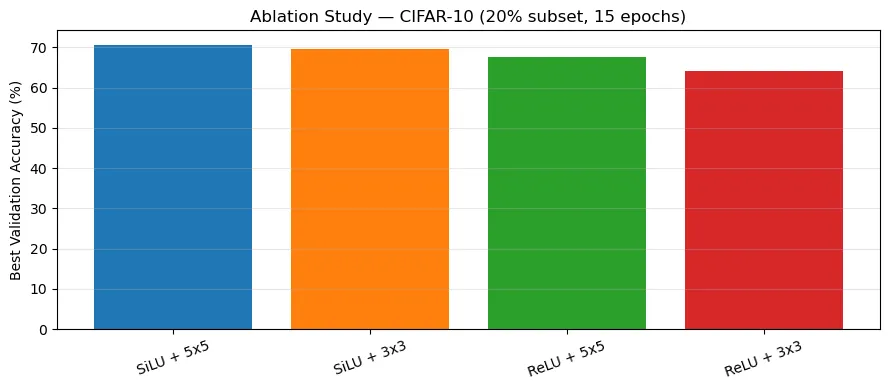
A controlled ablation: two activations × two kernel sizes on the same 9,000-image subset for 15 epochs. SiLU with 5×5 kernels won, at 70.66% validation accuracy.
- 03
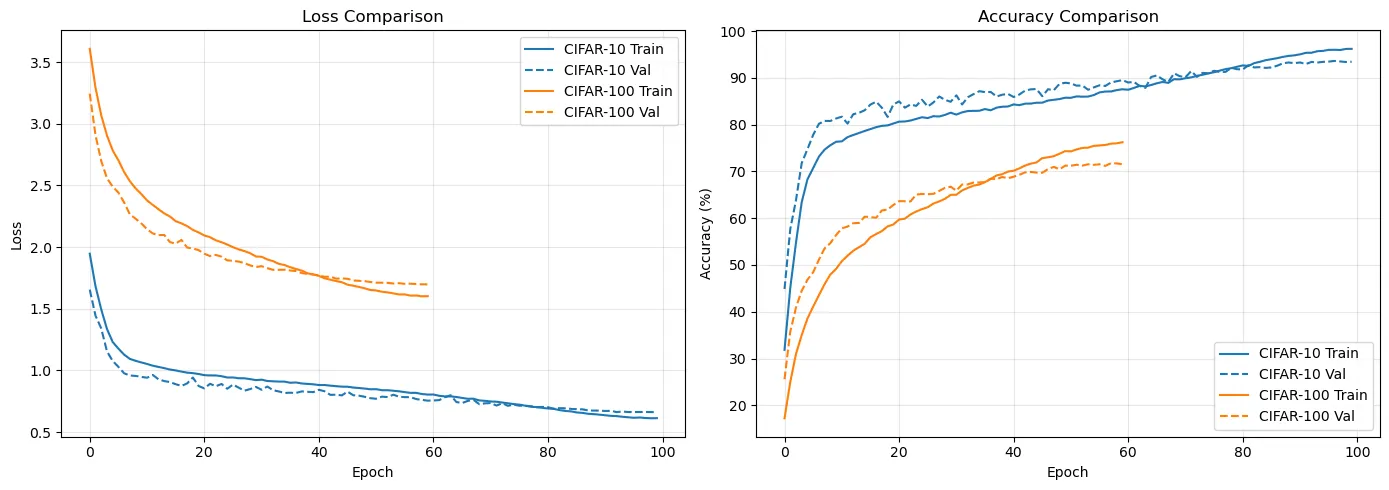
The selected 7.6M-parameter network — six residual blocks over three stages — trained on CIFAR-10 for 100 epochs.
- 04
For CIFAR-100: a new head, five warm-up epochs, then 60 epochs of fine-tuning.
- 05
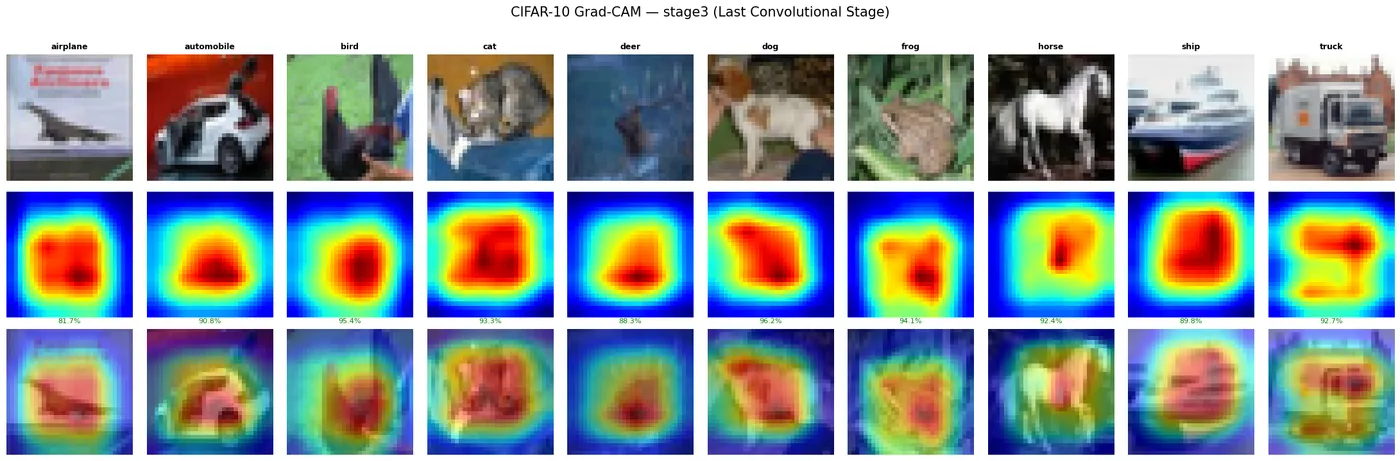
Then opened up: confusion patterns, confidence and calibration, feature maps and Grad-CAM.
Results
93.50%
CIFAR-10 test accuracy
72.35%
CIFAR-100 test accuracy after transfer
7.6M
parameters
0.0638
CIFAR-10 expected calibration error
Bottom line
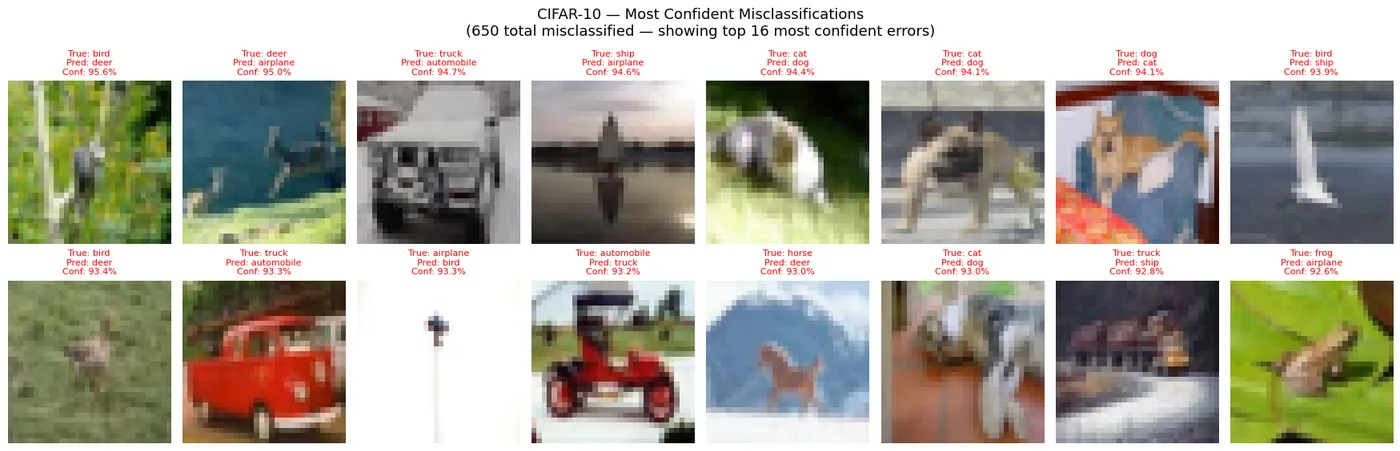
Visually similar animals stay hardest — 14.40% error on cats, 10.30% on birds, 10.10% on dogs — and correct predictions are more confident than wrong ones: 89.0% vs 60.5% mean confidence.
From the repo
Known limits
- —One seeded, course-scale run — it doesn't measure run-to-run uncertainty.
- —Grad-CAM is diagnostic evidence, not proof of the model's reasoning.
- —An honest student-scale benchmark, not a state-of-the-art claim.